
Should Countertops Match Your Floors? Design Tips for a Balanced Kitchen

It’s one of the most common questions homeowners ask when planning a kitchen upgrade:
Should your countertops match your floors?
The short answer is no—but they should absolutely work together.
A well-designed kitchen doesn’t rely on matching. It relies on balance, contrast, and thoughtful coordination. When done right, everything feels intentional without looking repetitive or overwhelming.
Here’s how to get it right.
Matching vs Coordinating: What Actually Works
Matching countertops and floors might sound like the safest option, but it can actually make a space feel flat and one-dimensional.
Instead, most well-designed kitchens follow a different approach:
Complement, don’t copy
Balance tones and textures
Create visual separation between surfaces
Think of your kitchen like a layered design. Each element—flooring, cabinets, countertops—should play its own role without competing for attention.
Start With Your Dominant Feature
Every kitchen needs a focal point.
In most homes, that’s either:
The countertops (especially if you choose a bold stone)
Or the flooring (if it has strong color or pattern)
Once you identify the dominant feature, everything else should support it—not match it.
Example:
If your floors have heavy variation or pattern → go simpler on countertops
If your countertops are bold and veined → keep flooring more neutral
This keeps the space from feeling busy or overwhelming.
Pay Attention to Undertones
This is where most design mistakes happen.
Even if colors look similar at first glance, the undertones can clash.
Warm tones (beige, gold, cream)
Cool tones (gray, blue, ash)
If your floors are warm-toned and your countertops are cool-toned, the kitchen can feel off—even if both materials look good individually.
Tip: Stick within the same temperature family, even if the colors are different.
Contrast Creates Depth
One of the easiest ways to create a high-end look is through contrast.
Instead of matching:
Light countertops + dark floors
Dark countertops + light floors
This adds depth and keeps each surface visually distinct.
It also helps highlight the craftsmanship of your countertops instead of blending everything together.
Texture Matters More Than You Think
It’s not just about color.
Texture plays a huge role in how your kitchen feels.
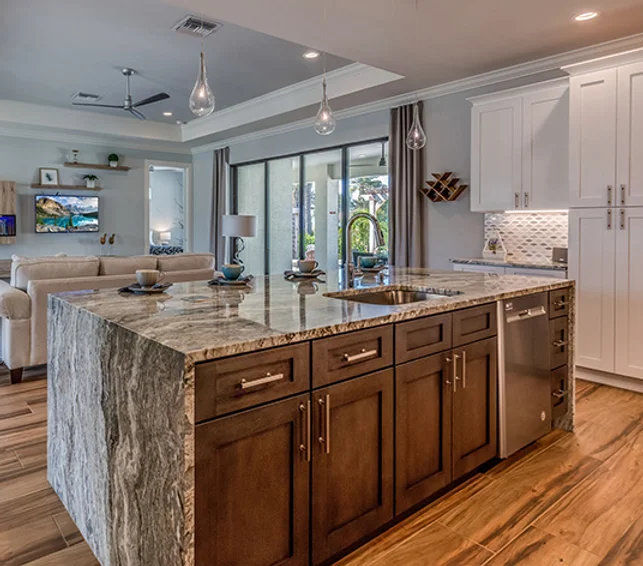
Smooth, polished countertops
Matte or textured flooring
Natural grain vs uniform surfaces
If everything has the same finish, the space can feel flat. Mixing textures adds subtle interest without making the design feel busy.
Consider Your Lifestyle
Design should always match how you live.
If you have:
Kids
Frequent guests
A busy kitchen
You may want combinations that hide wear better, like:
Mid-tone floors with subtle variation
Countertops that resist showing fingerprints or crumbs
A beautiful kitchen still needs to function day-to-day.
What Works Well in Florida Homes
In Central Florida, natural light plays a big role in how materials look.
Bright spaces can:
Make light colors feel even brighter
Highlight contrast more dramatically
Emphasize veining and texture
Because of that, many homeowners lean toward:
Neutral floors paired with statement countertops
Or balanced, mid-tone combinations that don’t feel too stark
Humidity and heat don’t directly impact design—but they do influence material choices, which can affect your overall look.
Common Mistakes to Avoid
Here are a few things that can throw off your kitchen design:
Trying to match everything exactly
This often makes the space feel unnatural and overly coordinated.
Ignoring undertones
Even small mismatches can make the whole kitchen feel off.
Overusing bold patterns
If both floors and countertops are busy, the space can feel chaotic.
Choosing materials separately
Decisions should always be made together—not in isolation.
The Goal: A Kitchen That Feels Intentional
The best kitchens don’t look like everything came from the same sample board.
They look balanced.
They feel natural.
And most importantly—they reflect how the homeowner actually lives in the space.
Bringing It All Together
Choosing countertops and flooring at the same time can feel overwhelming—but it’s also where great design happens.
Seeing materials side by side, comparing tones, and understanding how everything works together makes the decision much easier.
If you’re in the planning stage, getting guidance early can save time, money, and second-guessing later.
Design Your Kitchen With Confidence
If you’re unsure how to coordinate your countertops with your floors, you don’t have to figure it out alone.
Speak with our team about designing your kitchen upgrade and explore options that fit your style, your home, and how you actually use your space.


